My response to an article by Musa Mussadaq in Pakistan's Express Tribune:
http://tribune.com.pk/story/185978/30-of-pakistani-children-out-of-school-due-to-malnutrition/
When will the government learn – and when will the people realise their own folly? The government is happy to spend billions on arms that only help the western economies and massage the egos of army generals. The argument of defence is rubbish – if it’s India we’re worried about, we needn’t be. India is far too sensible to want to be lumbered with Pakistan’s population. If it’s Afghanistan, then perhaps we should stop meddling and thinking we’re a ‘player’ in the region. We’re not and acting as if we are has only encouraged gangsters and crime within Pakistan. With even a fraction of the defence budget, we could have – and still can – provide a decent education and credible opportunities to the next generation. Perhaps then we could also tell the sodding Saudis where to stick their money and not have the problem of madrassas and rampant fundamentalism within our borders.
Come on, we’re a happy, tolerant and reasonably clever people – let’s not waste our most important resource, our people. Never mind the government, what are the more affluent within the population doing? Buying property around the world? Shopping? Is anyone interested in setting up schools? Where are our own Rowntrees and Shaftesburys?
Friday, 10 June 2011

Thursday, 19 May 2011
Charitable giving & education - Islam and an investment model of morality
Call it synchronicity, call it mere coincidence, call it an over-active imagination, but -
Not long after my recent post on lifelong learning, I went to a Quran reading for a friend’s deceased parents held at a London
I assumed that it had been funded by money from Saudi Arabia, but a lady assured me that it had, in fact, been built through donations from the local community. She went on to explain how her husband, a veteran fundraiser, had discovered over the years that money was always forthcoming for mosques, cemeteries and Quran schools. However, when he had tried to raise money to build ‘ordinary’ schools 'back home', few seemed interested. This struck me as strange – and depressing.
Later, I reflected on the short sermon given by the imam at the end of the reading. Apparently, according to the Prophet, such Quran readings generated extra credit in the deceased’s ‘good deeds account’ on Judgement Day - or in common parlance, brownie points to aid entry intoParadise . Sweet. (So, if your parents end up in hell, it'll be your fault for not holding enough Quran readings on their behalf!) This triggered a chain of thoughts:
-> hadiths quite often link the doing of a particular deed to benefits on Judgement Day –do this and X sins will be forgiven, do that and you will receive so many good deeds, recite this so many times ... ->
-> The religion appeared to have a rather low opinion of its adherents if it felt that moral behaviour could only be induced by offering these ‘bribes’ – as if there was no other reason for doing good. (Granted, Islam is not alone in this and it is common to most religions.) ->
-> I remembered a saying I had heard quite often as a child: paradise lay at the feet of your mother.(No, I was not horrid to my mother nor particulary naughty!) Thinking about this now, I find it shocking – what kind of people need to be bribed (with heaven or anything) to love their own mother?
More generally, how might this trade in good deeds shape their view of morality? And what does this say about the religion’s ability to win the moral argument? (Some would argue that it had long since lost it by the morally dubious if not plain ridiculous 'pricing' of martyrdom at 72 virgins, but we will leave that for another post!)
Later, I reflected on the short sermon given by the imam at the end of the reading. Apparently, according to the Prophet, such Quran readings generated extra credit in the deceased’s ‘good deeds account’ on Judgement Day - or in common parlance, brownie points to aid entry into
-> hadiths quite often link the doing of a particular deed to benefits on Judgement Day –do this and X sins will be forgiven, do that and you will receive so many good deeds, recite this so many times ... ->
-> The religion appeared to have a rather low opinion of its adherents if it felt that moral behaviour could only be induced by offering these ‘bribes’ – as if there was no other reason for doing good. (Granted, Islam is not alone in this and it is common to most religions.) ->
-> I remembered a saying I had heard quite often as a child: paradise lay at the feet of your mother.(No, I was not horrid to my mother nor particulary naughty!) Thinking about this now, I find it shocking – what kind of people need to be bribed (with heaven or anything) to love their own mother?
More generally, how might this trade in good deeds shape their view of morality? And what does this say about the religion’s ability to win the moral argument? (Some would argue that it had long since lost it by the morally dubious if not plain ridiculous 'pricing' of martyrdom at 72 virgins, but we will leave that for another post!)
Of course, the Prophet was a trader by profession, so perhaps the metaphors of bargaining, pricing and returns came naturally to his thinking. Perhaps the people he was preaching to also had trader mentalities, although this dents somewhat the much-trumpeted claim that Islam is a universal religion for all time. Moreover, given that Islam was a new movement, spreading the word and bringing more people into the ‘fold’ were no doubt important. (There are several hadiths regarding the benefits of building mosques, with one even promising an equivalent house in paradise.)
But 1400 years later, Islam is a global religion with a significant presence. The problem for it and Muslims today is not quantity, but quality. There might be more than a billion Muslims in the world, but the vast majority are illiterate and live in countries that rank as the most dishonest, corrupt and dirty, with appalling human rights - hardly a recommendation for the religion now, is it?
But 1400 years later, Islam is a global religion with a significant presence. The problem for it and Muslims today is not quantity, but quality. There might be more than a billion Muslims in the world, but the vast majority are illiterate and live in countries that rank as the most dishonest, corrupt and dirty, with appalling human rights - hardly a recommendation for the religion now, is it?
Schools on the other hand, are more ambiguous. While the Prophet might have urged his followers to travel as far as China in search of knowledge, as far as I know this didn’t increase one’s chances of getting into Paradise . So, like canny businessmen, were people merely following earlier advice that offered the best and surest ‘returns’ in the next life? And with morality so firmly based on rewards in the afterlife, no wonder the Prophet made such a fuss about the importance of believing in a heaven and the next world!
Or am I just being cynical?
But what are the effects of such a view? Ostensibly, the strategy could be seen as clever – a win-win situation: the donators get into heaven, and the money brings in not just more recruits but hopefully observant Muslims that benefits the rest of society. Unfortunately, it hasn’t worked out that way. I think this is due to a combination of adopting a narrow view of what constitutes religious practice and of education generally.
In his book Desperately Seeking Paradise, Ziauddin Sardar mentions an encounter with a minister for science and research in one of the Gulf states
Meanwhile, it is well-known that that same wealth funds a significant (if not major) part of the madrassas (religious schools) in Pakistan
On 4 January 2011, the governor of Punjab in Pakistan Pakistan to support his outrageous view
Mr Bennett-Jones questioned both the rationale for killing merely for dissenting, the issue of differing interpretations of texts and the editor’s acceptance of the views of men whose education was limited to a theological framework. Limited only according to him, the editor replied defiantly, but in their eyes (and presumably the editor’s) these mullahs were sufficiently educated. And there the matter rested.
Had it been just the editor, one could have dismissed him as a lone idiot, but there are many in the country who support his view. More alarmingly, a significant number of lawyers were keen to defend the murderer in court. One has to question the moral reasoning of such lawyers - to say nothing of the quality of education they received - to want to defend such cold-blooded murder. What hope is there of building a civil, law-abiding society - something sorely lacking in most Muslim countries.
Alarmingly, this attitude is not confined to the backstreets of Pakistan, but is alive and kicking in London as well - as is evidenced by the sickening story of a Religious Education teacher beaten up (and almost killed) by four conservative Muslims - who remain unrepentant. (see http://www.bbc.co.uk/news/uk-england-london-13566526 )
Alarmingly, this attitude is not confined to the backstreets of Pakistan, but is alive and kicking in London as well - as is evidenced by the sickening story of a Religious Education teacher beaten up (and almost killed) by four conservative Muslims - who remain unrepentant. (see http://www.bbc.co.uk/news/uk-england-london-13566526 )
So, on the one hand it is heartwarming to see Muslims giving so generously to help themselves, even if motivated by self-interest - especially, given the huge amounts of money governments spend on defence compared with education, unaware that their biggest enemy is not India, Israel or Zionists, but the ignorance that festers within their own borders and their own minds.
However, would it not also be admirable if thought were given to how that generosity is employed? If morality is to be based on an investment model (and I am not suggesting that it should), is it not advisable for investors to periodically check the performance of their ‘portfolio’? Is it not incumbent to ask if the enterprise conforms - and continues to conform - to what the religion claims to uphold? And if the charity benefits the giver, is it not also incumbent that it does likewise to the receiver too?
However, would it not also be admirable if thought were given to how that generosity is employed? If morality is to be based on an investment model (and I am not suggesting that it should), is it not advisable for investors to periodically check the performance of their ‘portfolio’? Is it not incumbent to ask if the enterprise conforms - and continues to conform - to what the religion claims to uphold? And if the charity benefits the giver, is it not also incumbent that it does likewise to the receiver too?
Or do the givers prefer to remain blissfully unaware of the havoc it wreaks on others? Is that havoc also part of the credit system and religion they subscribe to? Do they think they get a ‘commission’ on each atrocity committed – the better to secure their entry into paradise?
But wouldn’t it be ironic if on the Day of Reckoning, their accounts were shown to be swollen by misdeeds – misdeeds generated by the money they gave with Paradise in mind, and now good only to propel them in the opposite direction? No number of Quran readings, then, would be of any use. Unfortunately, it would also be too late for the country and of little comfort to those whose lives have been ruined by this sordid trade in ‘good’ deeds.
Friday, 6 May 2011
Lifelong learning and constructive recreation
In my previous post, I talked about how my curiosity in how the earth ‘worked’ led me to buy a dvd and a book on the subject to learn more. All very laudable, I’m sure – even if I say so myself! And I concede, that my initial literacy was an important contributory factor in motivating me. However, there is another point that I would like to explore here and that is the privilege of having the opportunity to learn more. At the risk of sounding an old fart, I can remember a time, when I would also have had the choice of enrolling in an evening class run by the local council. Sadly, over the years, that option has become increasingly difficult to find.
The temptation is to blame government cuts that were first introduced by the much celebrated Margaret Thatcher, and that have since continued, under both Conservative and Labour governments, eroding away at what was once a great institution – and all that it stood for. But I think blaming our leaders is too convenient and - worse - lazy. Certainly, the leaders – especially when they are as influential (I’m reluctant to use the word ‘charismatic’) as Thatcher and Blair- have contributed to the decline, but the wider society must bear some responsibility too. (Thatcher, of course, famously dismissed the very notion of 'society', which says a lot about her outlook.)
The temptation is to blame government cuts that were first introduced by the much celebrated Margaret Thatcher, and that have since continued, under both Conservative and Labour governments, eroding away at what was once a great institution – and all that it stood for. But I think blaming our leaders is too convenient and - worse - lazy. Certainly, the leaders – especially when they are as influential (I’m reluctant to use the word ‘charismatic’) as Thatcher and Blair- have contributed to the decline, but the wider society must bear some responsibility too. (Thatcher, of course, famously dismissed the very notion of 'society', which says a lot about her outlook.)
For those not familiar with adult education, it consisted of courses in a range of subjects that were offered by the local council’s education department and funded by a combination of local council and central government money. They were usually held in the evening, made use of local council school facilities and the fees set were, I think, affordable. Crucially, people enrolled out of interest and for pleasure, not to gain a qualification that they could wave in front of existing or prospective employers. In short, the courses offered constructive recreation in the belief that learning was a good and worthwhile activity in its own right and a tool for improvement in the broadest sense.
It was Napolean, I believe, who once dismissed the English as ‘a nation of shopkeepers’. It was an unjust and unkind assessment - in my experience, every nation, including the French, is to some extent a nation of shopkeepers and thank god for it. Commerce and trade are vital to the successful functioning and growth of any society. Yet, the shopkeeper’s daughter, Thatcher, was also a person with an outlook so narrow and so narrowly defined it scarcely deserves to be called a vision. She saw everything through the perspective of a provincial, money-minded upstart and it was a viewpoint that shaped the politicians and business leaders, as well as trends within the wider community, for the generation that followed. In fact, provincialism under her was almost a virtue to be celebrated.
And so, over time, the catalogues have got thinner, the range of courses more restricted and adult education has been either amputated or grafted onto an altogether different beast called Further Education. The New Labour/Blair government rebranded this concept as Lifelong Learning, though in a telling example of just how pervasive the Thatcher mindset was, this learning was largely geared towards gaining a qualification that was marketable. So, whereas before there was a palpable sense of learning for learning’s sake, the priority now is to get a qualification – any qualification, no matter how manufactured or trivial – that is marketable. Teaching too is judged on ‘progression’, i.e. whether the student progresses on to another course (and another qualification) or gets a job. The new mantra is ‘value for money’ and value = economic in their eyes.
Putting this in a wider context, both Thatcher and Blair were also keen to extend pub opening hours and Thatcher sold off council owned sports facilities (tennis courts and playing grounds), a trend that Blair’s New Labour did nothing to reverse. To me, this is a far greater indicator of their priorities than any rhetoric about nation building that they and their media cronies have thrown at us over the decades.
Sadly, the people have colluded in this decimation so that we are now also faced with library closures. With more leisure time, the classes, sports fields and libraries symbolised a constructive alternative to easy and lazy options like the mindless watching of TV, getting drunk at the local pub or shopping – and yet, that is precisely what Britain has been reduced to.
I can remember enrolling in classes ranging from woodwork, badminton, sewing and swimming to studying politics, philosophy and psychology. Moreover, I did so in the company of like minded individuals and going to evening classes was as much a social event as it was educational – in the broader sense. As an example, having made my own clothes, I am now filled with a mixture of admiration, awe and anger whenever I see how cheaply clothes are priced in London stores – do the people who crave more and more clothes at less and less cost have any idea what skill, time and effort goes into making these garments? Would they be prepared to get paid a pittance for the same amount of effort? "There but for Fortune go you and I", as the great poet once said. It’s the market say some – be that as it may, in the end markets and demand are shaped by people, but what shapes the people?
I have nothing against people wanting to improve their or their children’s personal economic circumstances. Indeed, I am a product of just such social mobility. However, I think it’s important to also ask the why, what and how underlying this desire for social mobility. What does moving ‘up’ mean exactly? Why do people want to move ‘up’, and how will you know if you have moved ‘up’? Unfortunately, for many, ‘more money’ is the answer to all three questions.
Since Thatcher, there has been a renewed admiration and respect for money; and both Thatcher and Blair encouraged a sort of cult of not only new money, but fast money. (Mr Blair’s post-prime ministerial pursuits are ample proof, if any were needed, of this!) It was not investment for the long-term, but profit in the short-term that became the measure of success; and success was always in terms of monetary gain. With quick profit, came fast and – worse still - conspicuous spending. I had thought this was a failing peculiar to the third world and a reason for rampant corruption in these countries. It was certainly true of Pakistan
This gluttony can be seen in the bonuses that people expect (as if salaries were just for turning up to work?) and the wares advertised and written about in weekend newspaper magazines and television, so that shopping is now a recreational activity in its own right.
Yet, I have met people like my local road sweeper, who saved each month in order to buy a season ticket to the BBC Proms music festival every summer; and a security guard who was a Friend of the British Museum
Instead, it is crass footballers, talentless pop stars, gluttonous bankers and wealthy tax dodgers who are honoured and respected. Their bombast and strutting leaves ordinary folk in thrall and awe and who then buy into this myth of wealth - ordinary folk like the Thatchers and Blairs of this world; upstarts who have never seen anything and are easily overwhelmed at the first sight of wealth. Moreover, with money and consumption elevated to objects of envy, application, effort and persistence are demoted in favour of instant gratification. It is then that the rot sets in.
Admittedly, there is a wider issue here: is it the role of government to mould a country’s people? They say "Stateways don’t change folkways”, and in any case, people must be free to decide and choose for themselves. But these concerns lead one to ask: what is the choice, who provides it and how does one choose? Some would answer: the market; others religion; and yet others happiness. I hope to pursue these and similar questions in future posts – and how these issues impact not just on the seeming decline of the West, but on the sorry state of the Muslim world, and indeed the third world in general.
Wednesday, 13 April 2011
Plate tectonics with Tartan Totty!
Let me introduce you to the geologist Dr Iain Stewart, Professor of Geoscience Communication at the University of Plymouth, UK.

source: http://www4.plymouth.ac.uk
It was Dr Stewart who first introduced me to stromatolites (among other things, see below) through an excellent TV series he made with the BBC, called Earth:the Power of the Planet. If you haven’t seen it, I would recommend you buy the dvd and the book (published by National Geographic). Together they make a superb introduction to Geology and the Earth’s physical evolution.
If you find the mere mention of geology a turn-off, think again – you are turning away from your own history, your place in the universe and the potential contained in that knowledge. Traditional religion provides ready, if puerile, answers; but a god that allows earthquakes, famines, mass rape and disabilities has no business telling me what is right and wrong and how to lead my life, much less expect my subservience or obeisance.
If you find the mere mention of geology a turn-off, think again – you are turning away from your own history, your place in the universe and the potential contained in that knowledge. Traditional religion provides ready, if puerile, answers; but a god that allows earthquakes, famines, mass rape and disabilities has no business telling me what is right and wrong and how to lead my life, much less expect my subservience or obeisance.
As I have grown older, I have become more conscious of my own mortality and the passing away of my parents has served to heighten this feeling. Of course, we know everyone is going to die, but when you’re younger it all seems so far away and something that happens to other people. But then – one day you wake up and you realise: you’re on that conveyor belt too and there’s nothing, NOTHING you can do to stop it. You only hope you won’t be plucked before you fall off the end!
The changes that each season brings begin to take on a special significance and you realise: this is the way of Nature, this is the Way and you are part of it. You look at trees and marvel at their resilience. Some were there before you were even conceived! And the mountains and rivers – the very land, the moon, the planets … there’s no stopping the thought, and there’s no stopping the world to get off – you're part of it and there’s nowhere to get off to. And you wonder – why? I do, and if you haven’t, perhaps you should!
At school, I found geography boring and dropped it at the first opportunity, preferring to study biology instead. I have never regretted my decision, but now I was keen to learn about something equally valuable and interesting - why is the earth the way it is. And quite by chance I came across Dr Stewart’s programme. As they say: when the student is ready, the teacher will appear. I was certainly ready, and geology teachers don’t come much better or better looking than Professor Stewart! (Take note, Professor Brian Cox)
Professor Stewart begins the series by standing at the edge of a volcano in Ethiopia

source: http://www.school-portal.co.uk
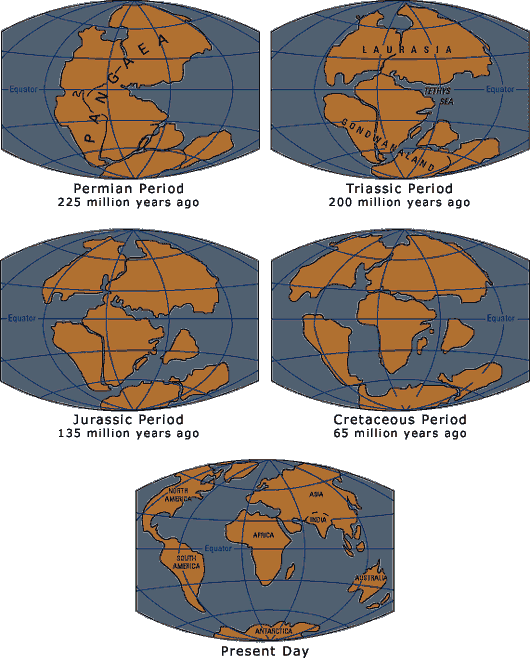
Simple isn’t it? No need for divine vengeance or anger - in fact no need for divine anything - just the natural outcome of a process driven by heat and pressure. It was first suggested by the German geophysicist Alfred Wegener (among others, I believe) in around 1912 and was called continental drift at the time. Advances in technology and knowledge have proven it to be correct and, more to the point, an on-going process that is driven by convection. Perhaps the pictures below will help you appreciate what this means:
source: http://www.exploratorium.edu

source:www.geography-site.co.uk
You see, there will always be earthquakes. All of us are living on giant floating slabs that long, long ago were all huddled together. People have called this land mass a large continent and given it the name of Pangaea or Gondwana at different times. These slabs or plates have been drifting and will continue to drift - colliding against each other in their travels. These travels contain within them another fascinating story about the evolution of life - and so us, but that is another post!
Of course, there are other factors that contribute to shaping our earth, for example water – as rain, river and ice. The whole process unfolds over many, many years that make our own lifespan seem fleeting in comparison. It's a humbling thought and perhaps one that should be borne in mind more often. It's the process that will continue long, long after we've gone and been reclaimed by that process. We're little more than blips thrown up, only to fall back into the shifting cauldron that is the earth.
And earthquakes are part of that cauldron, part of the earth's very fabric - they have happened, continue to happen and will continue to happen, no matter how good we all are! Being good has nothing to do with it. We are all vulnerable, regardless. And it is this shared vulnerability that binds us. As Phil Ochs said so eloquently: There but for Fortune go you and I.
If there is a god, that god is within each of us and it is there - in ourselves and in each other - that we must seek any benevolence, kindness and even mercy. There is only each other. If there is a heaven, that is where we'll find it. I shall allow the full significance of this to sink in - and if I have aroused your interest to learn more and numbed your vanity so that you reflect on Life and your life, I would have succeeded in my first objective in writing this post.
My second objective will be the topic of my next post. 'Till then, I leave you with another picture of the delicious Dr Stewart!

source: sciencefestival.co.uk
ps: I shall be away for the Easter break, so the next post will not be for a while (sighs of relief).
Saturday, 9 April 2011
In the beginning ...
I look at the picture below and marvel - at Life. Life that is approximately 3 billion - yes, BILLION - years old. I see them as my ancestors - ancestors that are still with us (in Western Australia, to be precise) ... and stories about an Abrahamic god fashioning us out of clay seem childish, if not plain ridiculous. I have no need for these stories in Genesis or the Quran, of Adam and Eve, or of gods moulding, shaping, belching, farting or excreting the world.

I look at the picture and I see something sacred, something deserving of reverence and awe. If I were to go on pilgrimage, it would be to here and not Jerusalem or Mecca or Varanasi; if I were to bow my head, again it would to these beings - not to Mecca or some idol. For these stromatolites* remind me, like nothing in the Abrahamic texts can ever hope to, of the miracle of life, of my being here, typing these words - and that I am not a lone product, but one amongst many; and that other people too are a result of that same process, that same miracle.
I look at the picture and can almost sense the stromatolites 'looking' out at the world with all its war, poverty , pollution and hate, and wondering: was it for this that we emerged and rose all those years ago?
I look at the picture and can almost sense the stromatolites 'looking' out at the world with all its war, poverty , pollution and hate, and wondering: was it for this that we emerged and rose all those years ago?
So, let us pause from all our hate and haste - and reflect instead on our shared origins, on being alive and how it all might never have happened. Let us value each moment and not waste it in vain prejudice or petty squabbling. We might never have existed at all and we will not come this way again. None of us. Ever.
 source: http://www.daviddarling.info/encyclopedia/S/stromatolite.html
* stromatolite
"A rounded, multilayered, structure, up to about 1 meter across, formed by microbial mats in which a rock-like layer of either sand or precipitated minerals is also present. stromatolites constitute our earliest and most pervasive direct record of life on Earth and have been found in rocks dating back at least 2.8 billion years. Although many stromatolites are fossils, there are a number of locations on the modern-day Earth where stromatolites are still forming, as shown in the illustration." (ibid)
Subscribe to:
Posts (Atom)